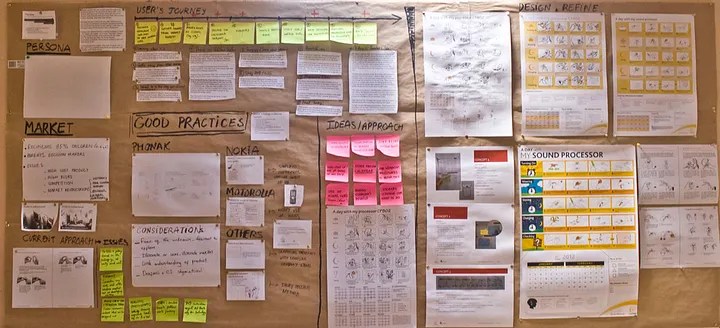
There’s a moment that happens in almost every creative review. The team has been working for weeks. There are campaign concepts taped to the wall, headlines covering the whiteboard, and mood boards spread across the table. Someone has built a deck with 30 beautifully designed slides. The room is full of good ideas, which is a great problem to have.
I’ve sat in enough creative reviews to know that the hardest part of the job usually isn’t coming up with ideas. It’s deciding which ones deserve to survive. Sometimes the answer is obvious, but most of the time, it isn’t.
So, you debate and rearrange. You combine two concepts into one. You realize your favorite headline is clever but doesn’t actually solve the problem. You kill a visual that took days to create because it distracts from the story. You remove half the slides because the presentation is trying to do too much. By the end of the meeting, you’ve made something better. Not because you added more, but because you chose less.
For most of my career, I thought my job was creating. Lately, I’ve started to think my real job has always been choosing. That realization has become impossible to ignore over the past year.
Like most creatives, I’ve spent a lot of time experimenting with AI. I’ve asked it to generate headlines, outlines, campaign ideas, positioning statements, image prompts, and even first drafts of articles. The results are often impressive, and sometimes they’re genuinely good. Every now and then, they surprise me.
But what’s interesting isn’t how quickly the ideas appear, so much as what happens next. I read through the options, borrowing the rhythm from one and the insight from another. I delete the obvious metaphor and ignore the headline that sounds the cleverest because I know it won’t resonate with the audience. I combine three ideas into one that didn’t exist before. Twenty-five possibilities eventually become one clear direction, and somewhere in that process, I realized that the value wasn’t in generating the options. The value was in knowing what deserved to survive.
I think we’ve been asking the wrong question about AI. The conversation has mostly centered around whether it can create, but the more interesting question is who decides what’s worth creating in the first place. We no longer live in a world where ideas are scarce. If anything, we’re drowning in them.
Instead, the value has shifted somewhere else entirely—toward judgment, restraint, or even discernment. Dare I say toward taste? When I say taste, I don’t mean it in the sense of personal preference. I’m referring to it as the ability to recognize what matters—knowing when a campaign is trying too hard or a story has one twist too many. It’s being able to tell the difference between what’s impressive and what’s meaningful, and understanding that just because you can make something doesn’t always mean you should.
I’ve come to believe that some of the most important creative decisions never make it into a portfolio. They’re the ideas you killed, the trend you ignored, or the meeting where someone had the courage to say, “We’re solving the wrong problem.” Nobody applauds those moments. There’s no award category for restraint and no Cannes Lion for removing twelve slides from a presentation. Sigh…
But over time, I’ve noticed that the creative leaders I admire most aren’t the ones who generate the highest volume of ideas. They’re the ones who create clarity and know what to leave behind. They know what deserves another round of thinking and when a campaign is finished—not because there’s nothing left to add, but because there’s nothing left worth adding.
Maybe that’s why I feel optimistic about where creative work is headed. Yes, technology will continue to evolve. We’ll have more tools, options, and ways to make things faster than ever before. But none of that changes the human part of the job. Only humans can decide what feels true and understand people well enough to know what will resonate. Someone still has to recognize when the clever answer isn’t the right one.
For years, I thought my value came from making things. Now I think it comes from knowing what deserves to be made. And if that’s true, then maybe taste isn’t just another creative skill. Maybe it’s the last competitive advantage we have left.


Leave a comment